The body is an unreliable videogame.
On February 13, I injured my leg on a run. I knew something wasn’t right as I approached home after a lunchtime 10K. I was upping my weekly mileage as I followed a training plan I found online to prepare me for a half marathon that was, at the point of the injury, about a month and a half away. I was trying a new route that day, crossing a major highway near my home via a pedestrian overpass. I didn’t want to lose time (ha), so I ran up and down the concrete steps. When I reached the other side—about 3.5 miles into my intended 6.5 mile run—I knew something had gone wrong. There was a sharp pain in my left glute with each stride. I ignored it, thinking it would work itself out on the back half of the run. I pushed ahead, and the pain dulled. Or so I told myself.
Shortly after the run, I found that I was limping badly. It hurt to simply walk or even just to put weight on it. I had to sit down to put on pants in the morning. Stairs were a challenge. I can tell you now that I thought I took an entire week off to let myself recover from whatever it was I did. But, no, that wouldn’t be true. Because I track all my runs, I can see that I only gave myself four days off and then went out on a 3.5-mile run. Sure, it was a Zone 2 run (keeping my heart rate at 60–70% of its maximum, which for me meant around 140ish beats per minute), but still: I could feel that something was still wrong. It would be at this point that you would assume that I would really give myself some time off to heal. But no. Two days later, my stats tells me, I went out and completed another 3.5-mile run, this time at an attempted race pace. Worse, my app tells me that I had input it as a 7-mile run, only reaching half of my apparent goal. I was pushing myself back to my peak, despite being in an obvious valley.
Surely now I would rest. No. Buzzer noise. Wrong-o. Three days later, I ran a full 8 miles, attempting to get back on my training plan for my half marathon, which had me increasing my long runs each week to a maximum of 10 miles a few weeks before the 13.1 mile race. I actually did manage to do this one at close to my race pace. But the pain was there. It was very much there. The next day I found myself badly limping again, traveling with my wife to an event, trying to pretend like I wasn’t worried that I’d really messed something up, that I’d made a bad thing worse.
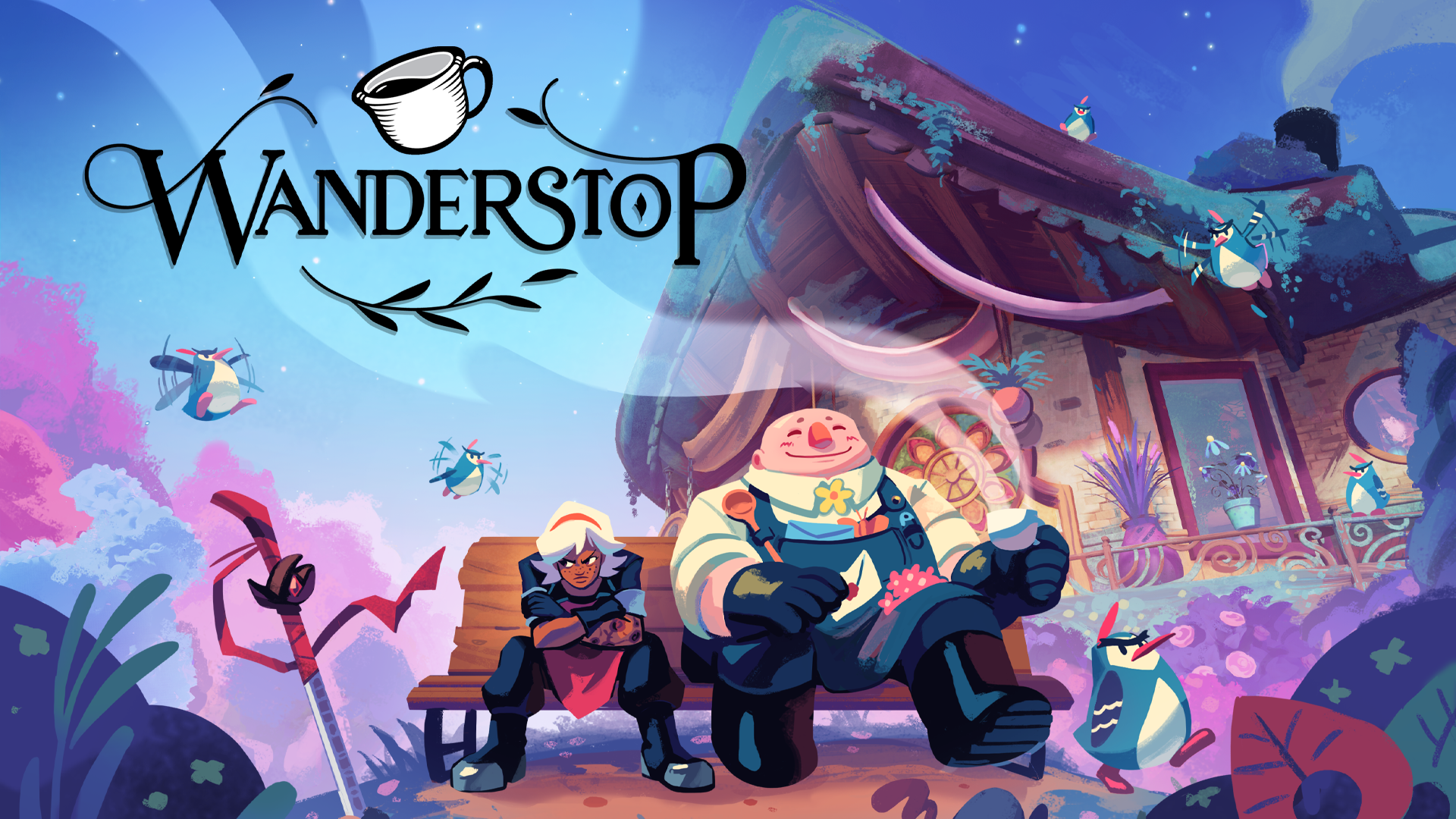
Wanderstop is a game about burnout, as many have written. But it’s also a game about injury.
It opens with our protagonist Alta sprinting through a forest, growing tired and unable to continue carrying herself forward. You are given the option when Alta stops, crumpled over in exhaustion, to tell yourself to rest or to tell yourself to keep pushing. Eventually, though, no matter what you do, Alta collapses and finds herself awakening on a bench next to a mountain of a man: Boro, the proprietor of Wanderstop, a tea shop that exists in a liminal, limbo-like space. Nearby to the bench is Alta’s sword, which she finds she can’t pick up. It is impossibly heavy. Boro, however, can lift it easily. He claims it weighs as you would expect a sword to weigh, but Alta, a former champion of a warrior, cannot lift it for the life of her. She cannot budge it an inch.
So begins a game about making tea when you’d much rather be kicking ass.
One of the things Wanderstop gets right about injury is that it is super annoying to stop and do nothing. Alta’s stature as a fighter—the best of the best—is relayed to the player strictly through exposition. This is not a Moonlighter-esque alternation between tea shop and arena fights. There is no uptime to counterbalance the downtime. We don’t get to experience Alta’s peak performance. We only hear about it. This is highly intentional, as it situates the game entirely within the realm of stopping. There is no “exciting” parallel game here to play. You are merely told of the excitement, of the achievement, of the dedication, and it works, because the game wants you to feel like you’ve hit a wall. And it achieves that by refusing to ever, ever give you any obvious rewards-based pleasure for making tea.
Here, roughly, is how you make tea in Wanderstop. First, you need to collect tea leaves from the bushes that surround the titular Wanderstop. Then, you have to dry those leaves in a process that takes several real-life minutes. There is no way to speed up this process, and it’s your first inclination that what we’re playing here is not a simulation of capitalism. There’s no upgrade path to make tea dry faster, nor any Basket+ to allow you to carry more leaves back to the tea shop. There’s even a bit of early game dialogue poking fun at the idea that you’d even look for something like that, wherein Alta asks Boro whether there are any tea-making metrics she should be improving. No, Wanderstop says. No, and stop it.
Once your tea leaves have dried, you proceed to making tea. To do so, you climb up a ladder to the top of a very tall tea-making contraption, pulling a rope to pour water into a reservoir. Then, you warm up that water by moving down the ladder, playing a small minigame similar to Stardew Valley’s fishing, wherein you have to keep pumping a bellows to keep a bar in the middle of a meter. There’s no way to fail this, however. You can take as long as you like, and screw up as much as you want. Once you finish heating the water, you go back up the ladder and around to the other side of the contraption, where you move the water from the reservoir to a brewing station. Then, you put in the leaves, and suddenly you have tea. Next, you open another valve and let the tea drip down to the pouring station, where you place a mug before pouring yourself or someone else a cup of tea.
This process never gets any less involved. In fact, throughout the game, you find yourself fulfilling more and more complicated requests from the people who visit Wanderstop, adding fruits and other ingredients that you must first grow, or following strange instructions to modify the steps described above. I don’t want to go too far into all of that, because my point is simply that you never optimize the process of tea-making. You simply make a lot of tea, again and again. It is slow. It is laborious. It is meant to feel slow and laborious. It is meant to feel like stopping. It is meant to make you want to do something else. For example: getting back to kicking ass.
Eventually, I sort of rested. I’d take several days off then attempt a one-mile run. Still, the pain persisted. So, then I’d take several more days off, then try another. Nope. Didn’t feel good. Eventually I found myself at the doctor, where I was given some anti-inflammatory medicine to help ease things back into motion after a full week of rest. I was encouraged to start slow and build back up. So that’s what I did. Well, that’s what I intended to do.
If you’ve ever trained for something like this, you know how disappointing it can be to find you’ve suddenly lost months of progress. It was as if somebody deleted my Elden Ring save file. You mean I have to do Limgrave again? The temptation is to sprint through the areas you already know. Yeah, yeah—I know what a 5K feels like. I don’t want to do that again. I want to get back to my longer runs. But, problem is, you can’t just do that, even if everything in you is screaming to just get back to your peak.
Around this time, I downloaded Gentler Streak. Something in the back of my mind remembered this article by Victoria Song on The Verge, and I thought, why not? (It helped that there was a super sale on a year’s subscription at the time, I feel compelled to admit.) I’ve never been one to try to fill my Apple Fitness rings every single day, but I found myself attracted to this app for the simple reason that, whereas Apple Fitness gamifies activity, Gentler Streak gamifies rest as well.
Gentler Streak wants you to build at a sustainable rate. It presents you with a graph of your activity levels, with three distinct areas: the lower part of your fitness level (where you should push), the middle (where you are working out healthily and within your ability), and the upper part (where you are pushing your limits). My first week with the app, I went above even the upper part twice, which made the app (gently) scold me. I was risking injury, it said. I should take it easy and recover. So what did I do? Well, I went above the graph a third time in a week, and insofar as the app is capable of being stern, it basically told me I really needed to listen to it, but more importantly, that I really needed to listen to my body.
But what was I supposed to do? Just stop?
[Minor spoilers for one character you encounter in Wanderstop ahead.]
At one point, Alta is visited by a customer named Ren. A former fighter himself, he remembers Alta, unlike every other visitor to Wanderstop. Once he realizes where he knows you from, he quickly devises a plan to help you get back on your feet and fight again.
The game gives you the opportunity to resist this line of thinking, but I did not. There was something so exciting about meeting someone who saw Alta as she saw herself: as someone who was only temporarily out of the game, but who could be back on top whenever she wanted. So when he asked Alta whether she might spar with him, I didn’t hesitate. Yes, of course. Yes, I would love to do anything other than make tea, which is so boring, oh my god.
The sparring does not go well. Alta once again finds herself exhausted, unable to keep up with Ren. It’s at this point that I expected the game to give me some kind of gentle reminder that I pushed myself too hard again, and that what I really need to do is to focus on rest. But that’s not what happens. Instead, Ren chastises Alta for lacking dedication, for losing sight of who she really is, and for basically not being who he thought she was. Insofar as one can be hurt by dialogue boxes, I found myself genuinely hurt by Ren. Especially since, on the other end of the controller, I was sitting there with my own pain and my own desire to return to my peak physical condition. It was, for me, adding insult to injury. I was mad at Wanderstop, honestly, and surprised I could feel that way toward a game.
Ren leaves Wanderstop shortly after, leaving you to contemplate whether perhaps he was right. Perhaps you have lost your way. Perhaps you aren’t who you say you are. Perhaps you are squandering your abilities. Eventually, though, Ren comes back, this time with an injury that he won’t soon shake off. He too pushed himself past his limits, and he too has paid a price for it. The two of you bond again, much more sadly than before, with no obvious resolution or answer to the pain you both now carry.
This past weekend, I ran my first 9-miler. It felt great. I’d worked my way back up from the valley to find myself at a new peak. Four weeks ago, after completing my round of meds from the doctor, I started to complete much shorter runs, my left glute still reminding me that something had indeed gone wrong there. It wasn’t a sharp pain, but it was a dull one, reminding me to go slow. Now, though, the worst I can say about how I feel is that my quads are sore, as is to be expected.
I missed the half marathon because my grandmother passed unexpectedly, and I had to travel for the funeral. In truth, though, I couldn’t have run the race safely regardless. I simply was not far enough into my recovery at that point to attempt such a thing. However, as I’ve learned, while there’s always another run, you only get the one body. I’m building back sustainably, with my eyes set on the Broad Street Run in just a few weeks. A 10-miler, yes, down from my intended 13.1, but there’ll be another half marathon in the future, I’m sure.
Wanderstop doesn’t have a world-shattering message about injury or burnout. It ends in a fairly neutral way, inviting the player to decide for themselves what they thought of all of it. It is indisputably pro-rest, but it doesn’t make any proclamations about how, exactly, to rest. It does however engage with the idea of making peace with the voice inside of you that pushes you toward extremes: extremes of labor, extremes of physicality, of ambition, of dedication, etc. It wants you to use the voice that says do more, not to be used by it. It wants you to hear it, but not be subsumed by it.
It’s interesting to me that, in my personal recovery, I’ve relied on a tool like Gentler Streak. Whereas Wanderstop wants me to shed the concept of gamified rest—to reject the idea that the escape from depressing repetition is energizing repetition, to get away from my inclination as a player to seek continual optimization—Gentler Streak is helping me to achieve my desire to push my upper limits without going so far beyond them that I injure myself again, crumpling, quite literally, like Alta in the woods. It gives me a chart and lets me watch number go up, and honestly? As a gamer? I love that shit. Clearly I, personally, am not ready to completely give up the quantified self. But I am looking for an alternative to treating my body like some kind of roguelike.
And that’s the thing: I play and think about games a lot, and running, to me, is a kind of game. But the body is an unreliable videogame. It is not a simplistic system of inputs and outputs. It is more complicated than a game, and more complicated than a chart in an app, whether that app is Apple Fitness with its Training Load or Gentler Streak with its Activity Path. There will be ups and downs, especially, in my case, if you are pushing your soon to be 35 year old body to extremes that even at 25 you would’ve struggled to attain.
But running is still a numbers game. It just is. There’s your time, of course, but there’s also your cadence, and your heart rate zones, and your vertical oscillation. There are numbers on numbers on numbers, all ready for you to obsess over as you push ever upward. But if I learned anything from stopping—both in life and in Wanderstop—is that you can’t let the desire to get back out there get in the way of stopping. There is value in stillness, if you can find it. And the motion, when it comes back around, will feel just as good, if not better.
Sign up for Backlog
A videogame newsletter for people who are behind on videogames
No spam. Unsubscribe anytime.
 Log in